Dental Assistants and Therapists
ISCO-08 3251 · 3 - Technicians and associate professionals
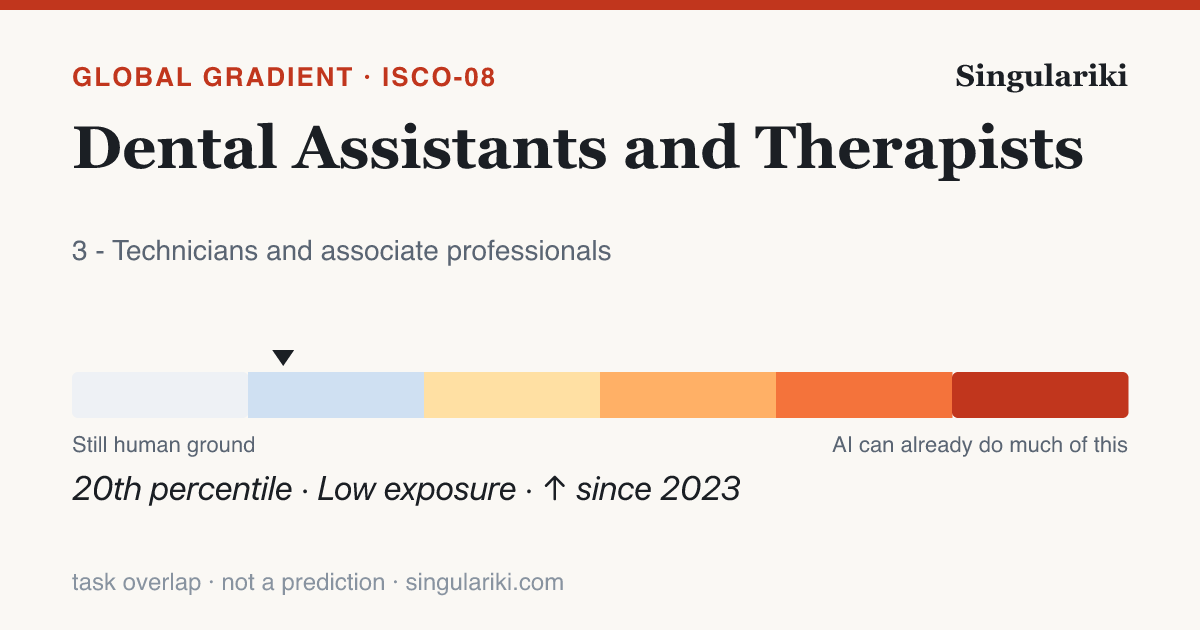
On the International Labour Organization's 2025 global study, the 8 task statements that define Dental Assistants and Therapists (ISCO-08 3251) score an average of 0.16 on a 0–1 exposure scale — more exposed than about 20% of the 427 placed occupations. Roughly 0% of its tasks fall somewhere on the exposed part of the gradient, and the typical task lands in the Not exposed band.
Exposure is task overlap, not a verdict. A high score means a generative-AI model can do part of the content of these tasks — it says nothing about whether the work is automated, whether anyone uses AI for it today, or whether jobs are lost. The gradient is scored on the international ISCO-08 system; the rest of Singulariki is U.S. O*NET/SOC, bridged below by an approximate, many-to-many crosswalk.
How its tasks split across the gradient
Each of the 8 scored tasks for this occupation, sorted into the six exposure bands — cool (human ground) to hot (almost fully assistable).
| Band | Tasks | Share | What it means |
|---|---|---|---|
| Not exposed | 8 | 100% | No meaningful GenAI capability on the task |
| Minimal | 0 | 0% | GenAI can touch the edges only |
| Gradient 1 | 0 | 0% | Lightly exposed — small assistable slices |
| Gradient 2 | 0 | 0% | Partly exposed — real assistable share |
| Gradient 3 | 0 | 0% | Heavily exposed — most of the task is assistable |
| Gradient 4 | 0 | 0% | Almost fully exposed |
The most-exposed task
“Advising communities and individuals on dental hygiene, diet and other preventive measures to reduce potential risks to oral health;”
Scores 0.38 on the 2025 scale. The task of advising communities and individuals on dental hygiene, diet, and other preventive measures to reduce potential risks to oral health involves a mix of informative content delivery, patient education, and personalized advice. Generative AI can significantly assist by creating educational materials, automating the distribution of information, and even personalizing tips based on general data patterns. However, AI cannot replace the nuanced understanding and personalized interaction required in healthcare, particularly in fields as person-centric as dental hygiene and diet advisory. The tasks semantically similar to this one, like participating in health promotion and disease prevention activities (score 0.275 to 0.39), and developing individual diets for children and adults (score 0.575), indicate a moderate level of potential AI assistance in structured environments but still emphasize the essential role of human judgment and interaction. Given the context of performing this task in a high-income country like Poland, where technology access can enhance AI's supportive role, the adjusted score reflects AI's capability to aid significantly while recognizing the irreplaceable human component in personalized health advice.
Moving fastest, 2023 → 2025
“Advising communities and individuals on dental hygiene, diet and other preventive measures to reduce potential risks to oral health;”
Model capability on this task changed by +0.08 in two years — the gradient is not static, it is filling in.
U.S. occupations this maps to
The American O*NET/SOC roles that crosswalk to ISCO-08 3251, biggest by employment first, via the published (approximate, many-to-many) IBS O*NET-SOC ↔ ISCO-08 correspondence. These are the closest U.S. matches — not an asserted one-to-one identity.
In context
Part of the 3 - Technicians and associate professionals major group. Return to the full gradient to see how the whole group sits.
Write a report on thisheadline · factoids · citation
Dental Assistants and Therapists sit at the 20th percentile of the global GenAI exposure gradient
- Across 427 international occupations scored by the ILO, Dental Assistants and Therapists rank in the 20th percentile for GenAI task exposure — overlap with what generative AI can attempt, not a projection of displacement.ILO / Gmyrek et al. (2025) GenAI exposure gradient
- About 0% of this occupation's tasks fall into an exposed gradient band.ILO / Gmyrek et al. (2025)
- Mean task exposure rose by 0.01 between the 2023 and 2025 model-capability snapshots.ILO / Gmyrek et al. (2025), 2023→2025
- Its most-exposed task: "Advising communities and individuals on dental hygiene, diet and other preventive measures to reduce potential risks to oral health;".ILO / Gmyrek et al. (2025)
Dental Assistants and Therapists sit at the 20th percentile of the global GenAI exposure gradient

• Across 427 international occupations scored by the ILO, Dental Assistants and Therapists rank in the 20th percentile for GenAI task exposure — overlap with what generative AI can attempt, not a projection of displacement. (ILO / Gmyrek et al. (2025) GenAI exposure gradient)
• About 0% of this occupation's tasks fall into an exposed gradient band. (ILO / Gmyrek et al. (2025))
• Mean task exposure rose by 0.01 between the 2023 and 2025 model-capability snapshots. (ILO / Gmyrek et al. (2025), 2023→2025)
• Its most-exposed task: "Advising communities and individuals on dental hygiene, diet and other preventive measures to reduce potential risks to oral health;". (ILO / Gmyrek et al. (2025))

Source: Singulariki — "Dental Assistants and Therapists". https://singulariki.com/gradient/3251-dental-assistants-and-therapists.html
Note: AI task overlap measures what today's AI can attempt, not automation, job loss, or a forecast.
AssetsShare imageMethodology & sourcesPress & newsroomThe newsroom
Every line is built only from figures this page already shows and cites. AI task overlap means what today's AI can attempt — not automation, job loss, or a forecast.
Datasets behind this page
Every figure above traces to a named public dataset and the exact release below — not hand-written opinion. See the full methodology for what each measure does and does not mean.
- O*NET 30.3 U.S. Department of Labor / National Center for O*NET Development
- ILO / Gmyrek et al. GenAI exposure gradient 2025 International Labour Organization
- IBS O*NET-SOC ↔ ISCO-08 occupation crosswalk 2022 Institute for Structural Research (IBS)