Sewing, Embroidery and Related Workers
ISCO-08 7533 · 7 - Craft and related trades workers
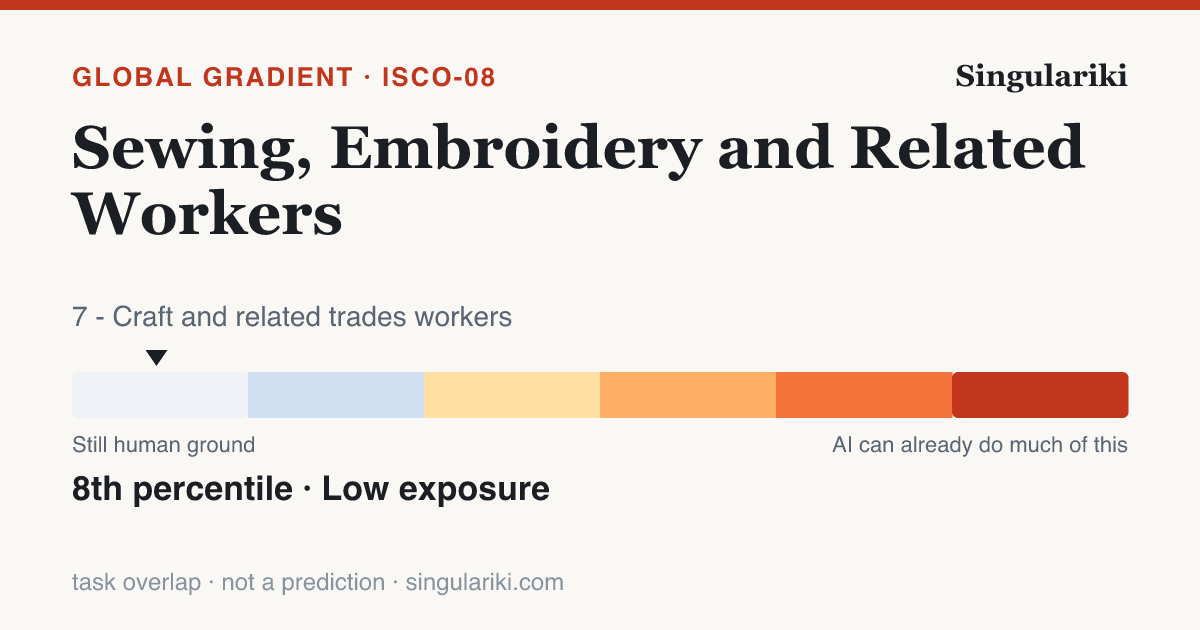
On the International Labour Organization's 2025 global study, the 12 task statements that define Sewing, Embroidery and Related Workers (ISCO-08 7533) score an average of 0.12 on a 0–1 exposure scale — more exposed than about 8% of the 427 placed occupations. Roughly 0% of its tasks fall somewhere on the exposed part of the gradient, and the typical task lands in the Not exposed band.
Exposure is task overlap, not a verdict. A high score means a generative-AI model can do part of the content of these tasks — it says nothing about whether the work is automated, whether anyone uses AI for it today, or whether jobs are lost. The gradient is scored on the international ISCO-08 system; the rest of Singulariki is U.S. O*NET/SOC, bridged below by an approximate, many-to-many crosswalk.
How its tasks split across the gradient
Each of the 12 scored tasks for this occupation, sorted into the six exposure bands — cool (human ground) to hot (almost fully assistable).
| Band | Tasks | Share | What it means |
|---|---|---|---|
| Not exposed | 12 | 100% | No meaningful GenAI capability on the task |
| Minimal | 0 | 0% | GenAI can touch the edges only |
| Gradient 1 | 0 | 0% | Lightly exposed — small assistable slices |
| Gradient 2 | 0 | 0% | Partly exposed — real assistable share |
| Gradient 3 | 0 | 0% | Heavily exposed — most of the task is assistable |
| Gradient 4 | 0 | 0% | Almost fully exposed |
The most-exposed task
“Embroidering ornamental designs on cloth by hand or machine using needle and coloured threads;”
Scores 0.14 on the 2025 scale. The task of embroidering ornamental designs on cloth by hand or machine is predominantly a manual, craft-based activity requiring precision, dexterity, and an artistic touch. This parallels tasks such as "Operating sewing machines or hand sewing" (score: 0.115) and "Finishing haberdashery products, sewing in linings" (score: 0.12), which involve similar manual skills and are rated low on automation potential. Additionally, tasks like "Placing trimming lines" (score: 0.135) and "Checking the correctness of sewing completion" (score: 0.265) further support this categorization. Generative AI can assist in pattern design or optimization but cannot replicate the nuanced human judgment and tactile feedback required for embroidery, even in a technologically advanced context like Poland. Thus, the adjusted score reflects the limited potential for automation, emphasizing the primarily manual and skill-intensive nature of the task.
Moving fastest, 2023 → 2025
“Embroidering ornamental designs on cloth by hand or machine using needle and coloured threads;”
Model capability on this task changed by +0.04 in two years — the gradient is not static, it is filling in.
U.S. occupations this maps to
The American O*NET/SOC roles that crosswalk to ISCO-08 7533, biggest by employment first, via the published (approximate, many-to-many) IBS O*NET-SOC ↔ ISCO-08 correspondence. These are the closest U.S. matches — not an asserted one-to-one identity.
In context
Part of the 7 - Craft and related trades workers major group. Return to the full gradient to see how the whole group sits.
Write a report on thisheadline · factoids · citation
Sewing, Embroidery and Related Workers sit at the 8th percentile of the global GenAI exposure gradient
- Across 427 international occupations scored by the ILO, Sewing, Embroidery and Related Workers rank in the 8th percentile for GenAI task exposure — overlap with what generative AI can attempt, not a projection of displacement.ILO / Gmyrek et al. (2025) GenAI exposure gradient
- About 0% of this occupation's tasks fall into an exposed gradient band.ILO / Gmyrek et al. (2025)
- Mean task exposure fell by 0.00 between the 2023 and 2025 model-capability snapshots.ILO / Gmyrek et al. (2025), 2023→2025
- Its most-exposed task: "Embroidering ornamental designs on cloth by hand or machine using needle and coloured threads;".ILO / Gmyrek et al. (2025)
Sewing, Embroidery and Related Workers sit at the 8th percentile of the global GenAI exposure gradient

• Across 427 international occupations scored by the ILO, Sewing, Embroidery and Related Workers rank in the 8th percentile for GenAI task exposure — overlap with what generative AI can attempt, not a projection of displacement. (ILO / Gmyrek et al. (2025) GenAI exposure gradient)
• About 0% of this occupation's tasks fall into an exposed gradient band. (ILO / Gmyrek et al. (2025))
• Mean task exposure fell by 0.00 between the 2023 and 2025 model-capability snapshots. (ILO / Gmyrek et al. (2025), 2023→2025)
• Its most-exposed task: "Embroidering ornamental designs on cloth by hand or machine using needle and coloured threads;". (ILO / Gmyrek et al. (2025))

Source: Singulariki — "Sewing, Embroidery and Related Workers". https://singulariki.com/gradient/7533-sewing-embroidery-and-related-workers.html
Note: AI task overlap measures what today's AI can attempt, not automation, job loss, or a forecast.
AssetsShare imageMethodology & sourcesPress & newsroomThe newsroom
Every line is built only from figures this page already shows and cites. AI task overlap means what today's AI can attempt — not automation, job loss, or a forecast.
Datasets behind this page
Every figure above traces to a named public dataset and the exact release below — not hand-written opinion. See the full methodology for what each measure does and does not mean.
- O*NET 30.3 U.S. Department of Labor / National Center for O*NET Development
- ILO / Gmyrek et al. GenAI exposure gradient 2025 International Labour Organization
- IBS O*NET-SOC ↔ ISCO-08 occupation crosswalk 2022 Institute for Structural Research (IBS)