Judges
ISCO-08 2612 · 2 - Professionals
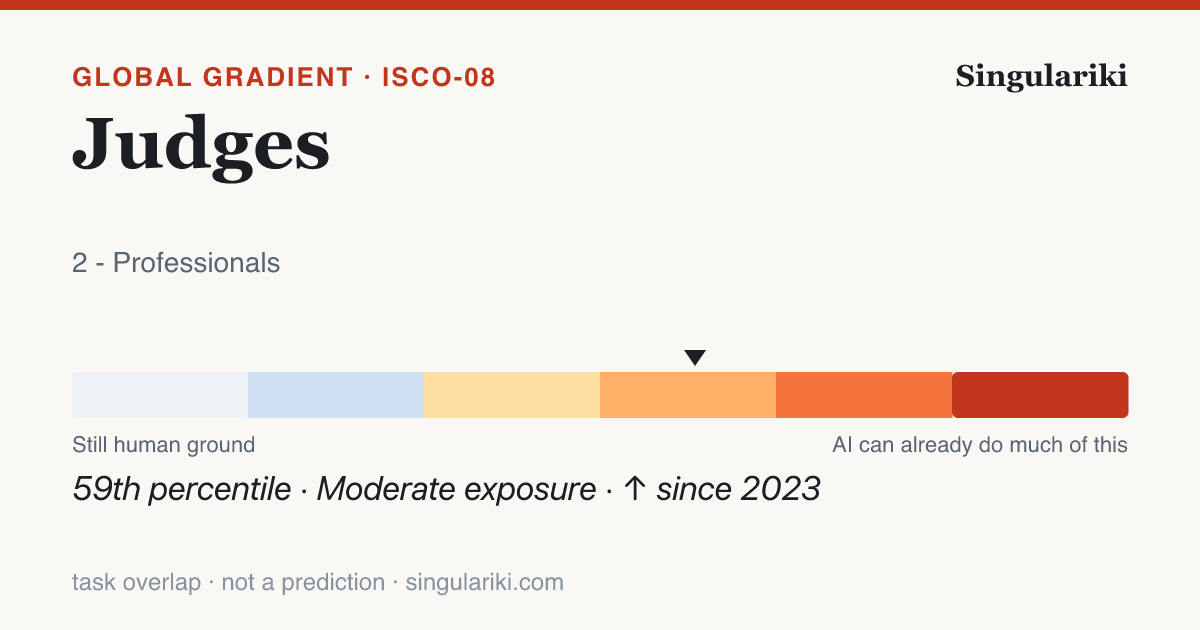
On the International Labour Organization's 2025 global study, the 7 task statements that define Judges (ISCO-08 2612) score an average of 0.31 on a 0–1 exposure scale — more exposed than about 59% of the 427 placed occupations. Roughly 0% of its tasks fall somewhere on the exposed part of the gradient, and the typical task lands in the Not exposed band.
Exposure is task overlap, not a verdict. A high score means a generative-AI model can do part of the content of these tasks — it says nothing about whether the work is automated, whether anyone uses AI for it today, or whether jobs are lost. The gradient is scored on the international ISCO-08 system; the rest of Singulariki is U.S. O*NET/SOC, bridged below by an approximate, many-to-many crosswalk.
How its tasks split across the gradient
Each of the 7 scored tasks for this occupation, sorted into the six exposure bands — cool (human ground) to hot (almost fully assistable).
| Band | Tasks | Share | What it means |
|---|---|---|---|
| Not exposed | 7 | 100% | No meaningful GenAI capability on the task |
| Minimal | 0 | 0% | GenAI can touch the edges only |
| Gradient 1 | 0 | 0% | Lightly exposed — small assistable slices |
| Gradient 2 | 0 | 0% | Partly exposed — real assistable share |
| Gradient 3 | 0 | 0% | Heavily exposed — most of the task is assistable |
| Gradient 4 | 0 | 0% | Almost fully exposed |
The most-exposed task
“Researching legal issues and writing opinions on the issues.”
Scores 0.41 on the 2025 scale. The task of researching legal issues and writing opinions on these issues requires substantial legal knowledge, critical thinking, and the ability to interpret and apply legal principles to various scenarios. Generative AI can assist significantly in gathering legal precedents, analyzing large volumes of legal texts, and drafting initial opinions, much like its role in the task of preparing opinions, certificates, rulings, and applications for disability, employment, and judiciary purposes, which scored 0.375. This task is inherently similar in that it involves document analysis and legal reasoning. While AI can automate data extraction and generate preliminary legal analyses, the nuanced interpretation of legal issues, case-specific judgment, and ethical considerations necessitate human expertise. Comparing this task with others in the same cluster and considering the socio-economic and technological context of Poland—where access to digital tools aids AI implementation—an adjusted score of 0.375 reflects a realistic balance between AI's supporting capability and the crucial requirement for human intervention as seen in comparable tasks.
Moving fastest, 2023 → 2025
“Passing sentence on persons convicted in criminal cases, determining damages or other appropriate remedy in civil cases and issuing court orders;”
Model capability on this task changed by +0.17 in two years — the gradient is not static, it is filling in.
U.S. occupations this maps to
The American O*NET/SOC roles that crosswalk to ISCO-08 2612, biggest by employment first, via the published (approximate, many-to-many) IBS O*NET-SOC ↔ ISCO-08 correspondence. These are the closest U.S. matches — not an asserted one-to-one identity.
- Judges, Magistrate Judges, and Magistrates
- Administrative Law Judges, Adjudicators, and Hearing Officers
In context
Part of the 2 - Professionals major group. Return to the full gradient to see how the whole group sits.
Write a report on thisheadline · factoids · citation
Judges sit at the 59th percentile of the global GenAI exposure gradient
- Across 427 international occupations scored by the ILO, Judges rank in the 59th percentile for GenAI task exposure — overlap with what generative AI can attempt, not a projection of displacement.ILO / Gmyrek et al. (2025) GenAI exposure gradient
- About 0% of this occupation's tasks fall into an exposed gradient band.ILO / Gmyrek et al. (2025)
- Mean task exposure rose by 0.04 between the 2023 and 2025 model-capability snapshots.ILO / Gmyrek et al. (2025), 2023→2025
- Its most-exposed task: "Researching legal issues and writing opinions on the issues.".ILO / Gmyrek et al. (2025)
Judges sit at the 59th percentile of the global GenAI exposure gradient

• Across 427 international occupations scored by the ILO, Judges rank in the 59th percentile for GenAI task exposure — overlap with what generative AI can attempt, not a projection of displacement. (ILO / Gmyrek et al. (2025) GenAI exposure gradient)
• About 0% of this occupation's tasks fall into an exposed gradient band. (ILO / Gmyrek et al. (2025))
• Mean task exposure rose by 0.04 between the 2023 and 2025 model-capability snapshots. (ILO / Gmyrek et al. (2025), 2023→2025)
• Its most-exposed task: "Researching legal issues and writing opinions on the issues.". (ILO / Gmyrek et al. (2025))

Source: Singulariki — "Judges". https://singulariki.com/gradient/2612-judges.html
Note: AI task overlap measures what today's AI can attempt, not automation, job loss, or a forecast.
AssetsShare imageMethodology & sourcesPress & newsroomThe newsroom
Every line is built only from figures this page already shows and cites. AI task overlap means what today's AI can attempt — not automation, job loss, or a forecast.
Datasets behind this page
Every figure above traces to a named public dataset and the exact release below — not hand-written opinion. See the full methodology for what each measure does and does not mean.
- O*NET 30.3 U.S. Department of Labor / National Center for O*NET Development
- ILO / Gmyrek et al. GenAI exposure gradient 2025 International Labour Organization
- IBS O*NET-SOC ↔ ISCO-08 occupation crosswalk 2022 Institute for Structural Research (IBS)