Teach academic, social, and life skills to kindergarten students with learning, emotional, or physical disabilities. Includes teachers who specialize and work with students who are blind or have visual impairments; students who are deaf or have hearing impairments; and students with intellectual disabilities.
Also called: Emotional Disabilities Teacher · Learning Support Teacher · Resource Program Teacher · Special Education Inclusion Teacher · Hearing Impaired Itinerant Teacher (HI Itinerant Teacher) · Special Education Resource Teacher · Academic Interventionist · Adapted Physical Education Teacher · Behavior Specialist · Blind Teacher · Braille Teacher · Cross-Categorical Special Education Teacher
A source-stamped Markdown brief of this occupation — paste it into an agent, or fetch
/roles/role-25-2055-00/context.md directly.
AI work map
A fast read on where AI already shows up in this occupation, where it stays a copilot,
where humans remain in the loop, and what the labor market is doing. Built from observed
Claude.ai conversations mapped to O*NET tasks and from published research — measures of
usage and exposure, not advice or predictions that the job is going away.
Market signal
Independent published positions, read together — not a forecast.
What today's research says about this occupation's exposure to AI, how AI is
actually being used in it, and where employment is headed. These are positions
within published studies — measures of exposure and usage, not predictions
that this job will disappear.
Exposure to current AI
Each study uses its own scale, so the raw scores are not comparable across rows —
the percentile (this job's rank among all U.S. occupations with
data) is the comparable figure, and sizes the bars.
Measure
Rank vs all occupations
Percentile
Score
LLM task exposure, γ (OpenAI / Eloundou) Moderate
38th
0.4
OpenAI's exposure study scores tasks three ways: with a language model alone
(α 0.1), with simple added tooling
(β 0.3), and including AI-powered software
(γ 0.4). Higher means more of the job's
tasks could be done at least twice as fast — not that they will be automated away.
How AI is actually used in this job
Among measured AI assistant conversations mapped to this occupation (Anthropic
Economic Index, 2026-01-15), these
task types came up most. These are shares of observed AI conversations —
not shares of the job, of worker time, or of what could be automated.
Present information in audio-visual or interactive formats, using computers, televisions, audio-visual aids, or other equipment, materials, or technologies.
1.9%
Observe and evaluate students' performance, behavior, social development, and physical health.
1.8%
Organize and display students' work in a manner appropriate for their perceptual skills.
1.1%
Teach socially acceptable behavior, employing techniques such as behavior modification or positive reinforcement.
0.3%
Interpret or transcribe classroom materials into Braille or sign language.
0.3%
Tasks
All 30 tasks O*NET lists for this occupation, ordered by importance.
Each links to its own page with AI-exposure and observed-use detail.
Most of these occupations require a four-year bachelor's degree, but some do not.
Related experience
A considerable amount of work-related skill, knowledge, or experience is needed for these occupations. For example, an accountant must complete four years of college and work for several years in accounting to be considered qualified.
Preparation level
SVP (7.0 to < 8.0) — total schooling plus on-the-job experience.
What to study:Education
. Fields of study crosswalked to this occupation (NCES CIP–SOC), not a requirement.
Interests & work styles
The interests and personal qualities O*NET associates with people who do this work.
AI task-overlap percentile (horizontal) vs. median-pay percentile (vertical), across all scored occupations. This occupation is highlighted; related occupations are plotted alongside it. Overlap measures shared tasks with AI, not automation.
Side-by-side comparisons place two occupations’ pay, preparation, skills, and AI
exposure on the same page — same data, same scale, no forecast.
What you can do with this
Options the data surfaces for Special Education Teachers, Kindergarten — not advice or a forecast. Each is a real
cross-link you can follow into the evidence.
Adjacent roles
Occupations O*NET rates as related — the nearby moves on the map.
▸Write a report on thisheadline · factoids · citation
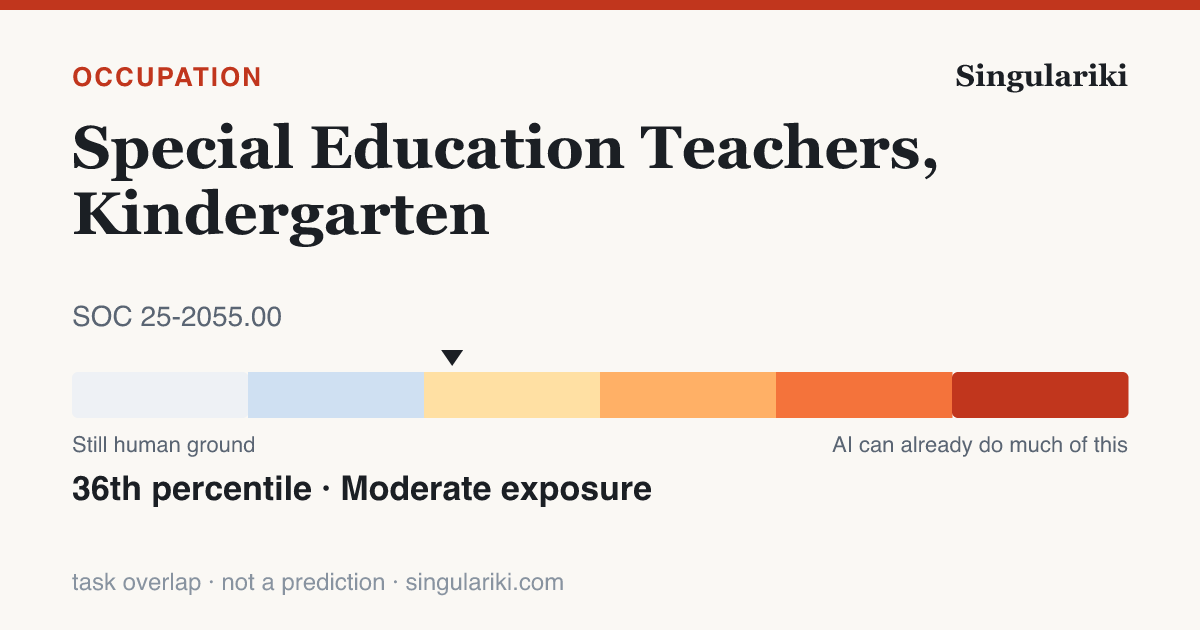
Special Education Teachers, Kindergarten sit at the 36th percentile of AI task overlap among U.S. occupations
Special Education Teachers, Kindergarten rank in the 36th percentile (Moderate band) for AI task overlap across U.S. occupations — a measure of how much of the work today's AI can attempt, not how much is automated.Eloundou et al. (GPTs are GPTs) + Felten AIOE
Copy the whole kit
Special Education Teachers, Kindergarten sit at the 36th percentile of AI task overlap among U.S. occupations

• Special Education Teachers, Kindergarten rank in the 36th percentile (Moderate band) for AI task overlap across U.S. occupations — a measure of how much of the work today's AI can attempt, not how much is automated. (Eloundou et al. (GPTs are GPTs) + Felten AIOE)

Source: Singulariki — "Special Education Teachers, Kindergarten". https://singulariki.com/roles/role-25-2055-00
Note: AI task overlap measures what today's AI can attempt, not automation, job loss, or a forecast.
Every line is built only from figures this page already shows and cites. AI task overlap means
what today's AI can attempt — not automation, job loss, or a forecast.
Sources for this page
Every figure above traces to a named public dataset and the exact release below — not
hand-written opinion. See the full methodology for what each
measure does and does not mean.
O*NET 30.3U.S. Department of Labor / National Center for O*NET Development
Data compiled June 2, 2026. Figures are estimates, not advice.
Cite this page
Plain
Singulariki. "Special Education Teachers, Kindergarten." Singulariki: a source-backed encyclopedia of work. Built from O*NET 30.3; Anthropic Economic Index v4 (2026-01-15) + v2 (2025-03-27); “GPTs are GPTs” (Eloundou et al.) arXiv 2303.10130. Accessed June 7, 2026. https://singulariki.com/roles/role-25-2055-00
APA
Singulariki. (2026). Special Education Teachers, Kindergarten. Singulariki: a source-backed encyclopedia of work. Retrieved June 7, 2026, from https://singulariki.com/roles/role-25-2055-00
BibTeX
@misc{singulariki-role-25-2055-00,
  title  = {Special Education Teachers, Kindergarten},
  author = {{Singulariki}},
  year   = {2026},
  note   = {O*NET 30.3; Anthropic Economic Index v4 (2026-01-15) + v2 (2025-03-27); “GPTs are GPTs” (Eloundou et al.) arXiv 2303.10130. Accessed June 7, 2026},
  url    = {https://singulariki.com/roles/role-25-2055-00}
}
Citations name the underlying public dataset releases — they reflect what this page is built from, not just the URL.
Embed this chart
Paste this into any page. It links back here for attribution.