Skills it runs on
The capabilities O*NET rates most important for this occupation — the human ground the work is built on.
See all skills →Occupation · SOC 29-1222.00
Diagnose diseases and conduct lab tests using organs, body tissues, and fluids. Includes medical examiners.
Also called: Anatomic Pathologist · Dermatopathologist · Forensic Pathologist · Pathologist · Cytopathologist · Hematopathologist · Neuropathologist · Oral Pathologist · Surgical Pathologist · Animal Pathologist · Autopsy Pathologist · Chemical Pathologist
Job family: Healthcare Practitioners and Technical Occupations
A source-stamped Markdown brief of this occupation — paste it into an agent, or fetch
/roles/role-29-1222-00/context.md directly.
A fast read on where AI already shows up in this occupation, where it stays a copilot, where humans remain in the loop, and what the labor market is doing. Built from observed Claude.ai conversations mapped to O*NET tasks and from published research — measures of usage and exposure, not advice or predictions that the job is going away.
The capabilities O*NET rates most important for this occupation — the human ground the work is built on.
See all skills →Independent published positions, read together — not a forecast.
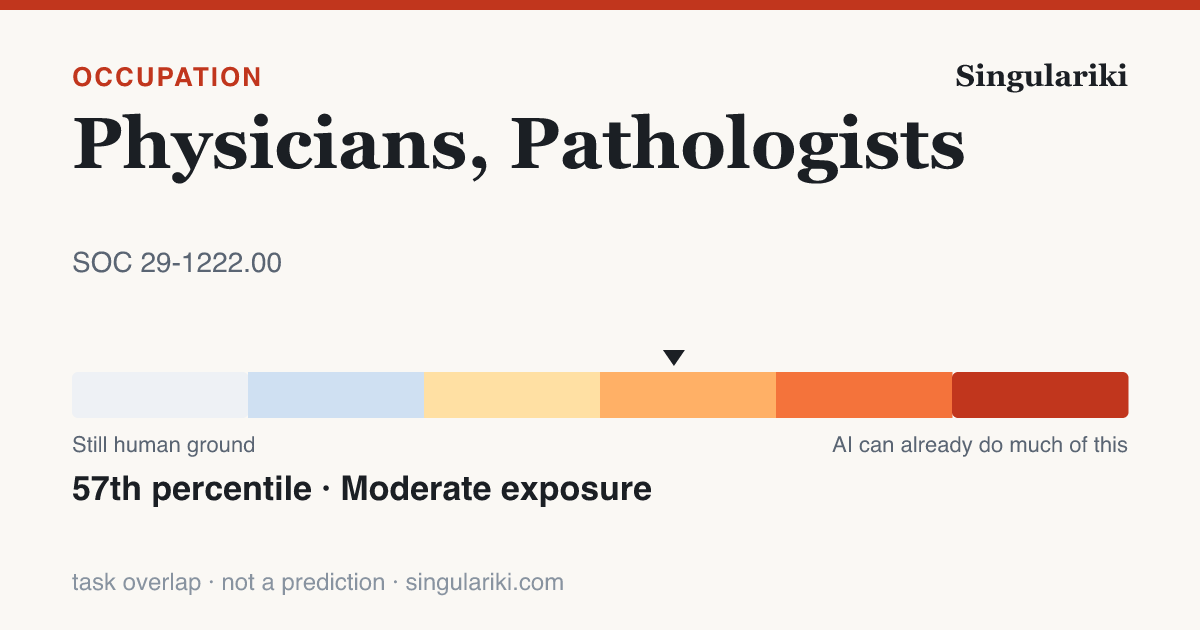
57th-percentile task overlap — yet about 400 openings a year (+4.2% projected, BLS) . What exposure means →
What today's research says about this occupation's exposure to AI, how AI is actually being used in it, and where employment is headed. These are positions within published studies — measures of exposure and usage, not predictions that this job will disappear.
Each study uses its own scale, so the raw scores are not comparable across rows — the percentile (this job's rank among all U.S. occupations with data) is the comparable figure, and sizes the bars.
| Measure | Rank vs all occupations | Percentile | Score |
|---|---|---|---|
| LLM task exposure, γ (OpenAI / Eloundou) High | 75th | 0.9 | |
| AI assistant applicability (Microsoft) Moderate | 40th | 0.1 |
OpenAI's exposure study scores tasks three ways: with a language model alone (α 0.1), with simple added tooling (β 0.5), and including AI-powered software (γ 0.9). Higher means more of the job's tasks could be done at least twice as fast — not that they will be automated away.
Among measured AI assistant conversations mapped to this occupation (Anthropic Economic Index, 2026-01-15), these task types came up most. These are shares of observed AI conversations — not shares of the job, of worker time, or of what could be automated.
| Examine microscopic samples to identify diseases or other abnormalities. | 2.1% | |
| Conduct research and present scientific findings. | 0.6% | |
| Communicate pathologic findings to surgeons or other physicians. | 0.4% | |
| Identify the etiology, pathogenesis, morphological change, and clinical significance of diseases. | 0.3% | |
| Develop or adopt new tests or instruments to improve diagnosis of diseases. | 0.2% |
Independent U.S. Bureau of Labor Statistics employment projection for 2024–2034 — a labor-market forecast, not an AI-impact forecast.
| Outlook | About average · +4.2% by 2034 |
| Projected annual openings | 400 |
| Employment 2024 → 2034 | 12,600 → 13,100 |
“Annual openings” counts new jobs plus replacements for workers who leave the occupation, so it can be large even when growth is modest.
All 19 tasks O*NET lists for this occupation, ordered by importance. Each links to its own page with AI-exposure and observed-use detail.
O*NET importance rating, from 1 (not important) to 5 (extremely important).
| Medicine and Dentistry | 4.8 | |
| Biology | 4.5 | |
| English Language | 4.3 | |
| Education and Training | 3.4 | |
| Customer and Personal Service | 3.4 | |
| Chemistry | 3.2 | |
| Administration and Management | 3.1 | |
| Computers and Electronics | 3.1 |
| Inductive Reasoning | 4.8 | |
| Problem Sensitivity | 4.4 | |
| Oral Comprehension | 4.3 | |
| Written Expression | 4.3 | |
| Written Comprehension | 4.1 | |
| Oral Expression | 4.1 | |
| Deductive Reasoning | 4.1 | |
| Near Vision | 4.0 | |
| Information Ordering | 3.9 | |
| Speech Clarity | 3.9 | |
| Category Flexibility | 3.8 | |
| Flexibility of Closure | 3.8 | |
| Speech Recognition | 3.8 | |
| Fluency of Ideas | 3.1 | |
| Speed of Closure | 3.1 | |
| Selective Attention | 3.1 | |
| Visual Color Discrimination | 3.1 |
| Reading Comprehension | 4.3 | |
| Writing | 4.1 | |
| Critical Thinking | 4.1 | |
| Active Listening | 4.0 | |
| Science | 4.0 | |
| Active Learning | 4.0 | |
| Speaking | 3.9 | |
| Monitoring | 3.5 | |
| Learning Strategies | 3.1 |
| Complex Problem Solving | 4.0 | |
| Judgment and Decision Making | 3.9 | |
| Instructing | 3.3 | |
| Time Management | 3.3 | |
| Social Perceptiveness | 3.1 | |
| Management of Personnel Resources | 3.1 |
Skills employers ask for in job postings for this occupation (Lightcast), with whether each is a common or specialized skill.
Showing the top 40 of 102.
How characteristic each condition is of the job, on O*NET's 1–5 context scale (higher = more present in day-to-day work). Each condition links to how it varies across all occupations.
What to study: Health Professions and Related Programs , Medical Residency/Fellowship Programs . Fields of study crosswalked to this occupation (NCES CIP–SOC), not a requirement.
Share of people in this occupation at each level of education.
| Post-Doctoral Training | 62.0% | |
| Doctoral Degree | 29.2% | |
| Master's Degree | 6.0% | |
| First Professional Degree | 2.7% |
The interests and personal qualities O*NET associates with people who do this work.
| Investigative | 7.0 | |
| Realistic | 4.9 | |
| Conventional | 4.7 | |
| Social | 3.6 |
| Medical Science | 6.6 | |
| Life Science | 6.4 | |
| Health Care Service | 5.4 | |
| Physical Science | 4.1 | |
| Mathematics/Statistics | 2.8 | |
| Teaching/Education | 2.6 | |
| Protective Service | 2.6 |
| Dependability | 6.0 | |
| Attention to Detail | 5.0 | |
| Integrity | 4.0 | |
| Intellectual Curiosity | 3.0 | |
| Cautiousness | 3.0 |
U.S. · annual wages (BLS OEWS)
| 10th percentile | $83,930 |
| 25th percentile | $165,940 |
| Median (50th) | — |
| 75th percentile | — |
| 90th percentile | — |
| People employed | 11,800 |
Where these workers are employed, by number of jobs (national, BLS OEWS). Pay shown is the occupation's national median, not industry-specific.
| Industry | Workers | National median pay |
|---|---|---|
| Health Care and Social Assistance · Sector | 10,350 | — |
| Professional, Scientific, and Technical Services · Sector | 350 | $154,800 |
| Educational Services · Sector | 350 | $224,840 |
| Wholesale Trade · Sector | 30 | $177,130 |
Industries where this occupation is far more common than in the economy as a whole. The location quotient is how many times more concentrated it is here (a value of 5 means five times its economy-wide share).
| Industry | Concentration | Workers |
|---|---|---|
| Health Care and Social Assistance · Sector | 5.85× | 10,350 |
| Professional, Scientific, and Technical Services · Sector | 0.42× | 350 |
| Educational Services · Sector | 0.34× | 350 |
Part of the Healthcare & Human Services career cluster.
Side-by-side comparisons place two occupations’ pay, preparation, skills, and AI exposure on the same page — same data, same scale, no forecast.
Options the data surfaces for Physicians, Pathologists — not advice or a forecast. Each is a real cross-link you can follow into the evidence.
Capabilities this work builds that are used across many other occupations.
Occupations O*NET rates as related — the nearby moves on the map.
How people typically prepare for this work.
See where this work sits in the bigger picture.
Physicians, Pathologists show 57th-percentile AI task overlap — and about 400 annual U.S. openings
Physicians, Pathologists show 57th-percentile AI task overlap — and about 400 annual U.S. openings

• Physicians, Pathologists rank in the 57th percentile (Moderate band) for AI task overlap across U.S. occupations — a measure of how much of the work today's AI can attempt, not how much is automated. (Eloundou et al. (GPTs are GPTs) + Felten AIOE)
• The occupation is projected to see about 400 U.S. job openings per year (2024–34), counting growth and replacement — a labor-demand projection made independently of AI. (BLS Employment Projections 2024–34)
• BLS projects employment to be about average (+4.2%) from 2024 to 2034. (BLS Employment Projections 2024–34)

Source: Singulariki — "Physicians, Pathologists". https://singulariki.com/roles/role-29-1222-00
Note: AI task overlap measures what today's AI can attempt, not automation, job loss, or a forecast.
AssetsShare imageMethodology & sourcesPress & newsroomThe newsroom
Every line is built only from figures this page already shows and cites. AI task overlap means what today's AI can attempt — not automation, job loss, or a forecast.
Every figure above traces to a named public dataset and the exact release below — not hand-written opinion. See the full methodology for what each measure does and does not mean.
Data compiled June 2, 2026. Figures are estimates, not advice.
Singulariki. "Physicians, Pathologists." Singulariki: a source-backed encyclopedia of work. Built from O*NET 30.3; BLS Occupational Employment and Wage Statistics (OEWS) May 2024; BLS Employment Projections 2024–2034; Anthropic Economic Index v4 (2026-01-15) + v2 (2025-03-27); Microsoft “Working with AI” working-with-ai; “GPTs are GPTs” (Eloundou et al.) arXiv 2303.10130. Accessed June 7, 2026. https://singulariki.com/roles/role-29-1222-00
Singulariki. (2026). Physicians, Pathologists. Singulariki: a source-backed encyclopedia of work. Retrieved June 7, 2026, from https://singulariki.com/roles/role-29-1222-00
@misc{singulariki-role-29-1222-00,
  title  = {Physicians, Pathologists},
  author = {{Singulariki}},
  year   = {2026},
  note   = {O*NET 30.3; BLS Occupational Employment and Wage Statistics (OEWS) May 2024; BLS Employment Projections 2024–2034; Anthropic Economic Index v4 (2026-01-15) + v2 (2025-03-27); Microsoft “Working with AI” working-with-ai; “GPTs are GPTs” (Eloundou et al.) arXiv 2303.10130. Accessed June 7, 2026},
  url    = {https://singulariki.com/roles/role-29-1222-00}
} Citations name the underlying public dataset releases — they reflect what this page is built from, not just the URL.