Perform medical tests in a laboratory environment for use in the treatment and diagnosis of diseases in animals. Prepare vaccines and serums for prevention of diseases. Prepare tissue samples, take blood samples, and execute laboratory tests, such as urinalysis and blood counts. Clean and sterilize instruments and materials and maintain equipment and machines. May assist a veterinarian during surgery.
Also called: Certified Veterinary Technician (CVT) · Licensed Veterinary Technician (LVT) · Registered Veterinary Technician (RVT) · Veterinary Technician (Vet Tech) · Emergency Veterinary Technician (Emergency Vet Tech) · Internal Medicine Veterinary Technician (Internal Medicine Vet Tech) · Veterinarian Technician (Vet Tech) · Veterinary Laboratory Technician (Vet Lab Tech) · Veterinary Nurse (Vet Nurse) · Veterinary Technologist · Animal Care Technician (Animal Care Tech) · Animal Health Technician (Animal Health Tech)
A source-stamped Markdown brief of this occupation — paste it into an agent, or fetch
/roles/role-29-2056-00/context.md directly.
AI work map
A fast read on where AI already shows up in this occupation, where it stays a copilot,
where humans remain in the loop, and what the labor market is doing. Built from observed
Claude.ai conversations mapped to O*NET tasks and from published research — measures of
usage and exposure, not advice or predictions that the job is going away.
Use as a copilot
Task areas where people work with AI — iterating, learning, or checking —
staying in the loop rather than handing the task off.
Provide information or counseling regarding issues such as animal health care, behavior problems, or nutrition. · 0.8%
↔26th-percentile task overlap — yet
about 14,300 openings a year
(+9.1% projected, BLS), and
observed AI use leans 5000% copilot, not hand-off (AEI)
. What exposure means →
AI & job outlook
What today's research says about this occupation's exposure to AI, how AI is
actually being used in it, and where employment is headed. These are positions
within published studies — measures of exposure and usage, not predictions
that this job will disappear.
Exposure to current AI
Each study uses its own scale, so the raw scores are not comparable across rows —
the percentile (this job's rank among all U.S. occupations with
data) is the comparable figure, and sizes the bars.
Measure
Rank vs all occupations
Percentile
Score
Overall AI exposure (Felten et al.) Moderate
38th
-0.4
LLM task exposure, γ (OpenAI / Eloundou) Low
29th
0.3
AI assistant applicability (Microsoft) Low
18th
0.1
OpenAI's exposure study scores tasks three ways: with a language model alone
(α 0.1), with simple added tooling
(β 0.2), and including AI-powered software
(γ 0.3). Higher means more of the job's
tasks could be done at least twice as fast — not that they will be automated away.
This job mostly cannot be done remotely (Dingel–Neiman) — its hands-on tasks sit outside what software-based AI reaches.
Historical automation estimate (2013)
A pre-LLM (2013) estimate of how automatable this job is by computerization and robotics. Shown for historical context only — it is not part of any current AI ranking.
Frey–Osborne probability 0.0 ·
18th percentile among occupations ·
Low
How AI is actually used in this job
Among measured AI assistant conversations mapped to this occupation (Anthropic
Economic Index, 2026-01-15), these
task types came up most. These are shares of observed AI conversations —
not shares of the job, of worker time, or of what could be automated.
Provide information or counseling regarding issues such as animal health care, behavior problems, or nutrition.
0.5%
Maintain controlled drug inventory and related log books.
0.3%
Job outlook
Independent U.S. Bureau of Labor Statistics employment projection for 2024–2034 —
a labor-market forecast, not an AI-impact forecast.
Outlook
Growing fast · +9.1% by 2034
Projected annual openings
14,300
Employment 2024 → 2034
134,200 → 146,400
“Annual openings” counts new jobs plus replacements for workers who leave the
occupation, so it can be large even when growth is modest.
Where this work sits on the global GenAI gradient
The ILO's 2025 global study scores generative-AI exposure on the international ISCO-08
occupation system, not US SOC. Bridged through the published (and approximate,
many-to-many) IBS O*NET-SOC ↔ ISCO-08 crosswalk, this US occupation corresponds to the
international occupation below. Exposure here means how much of the work's tasks today's AI can attempt — task
overlap, not automation, adoption, or jobs lost.
Veterinary Technologists and Technicians sits at the 15th percentile of 427
occupations on the global GenAI task-exposure gradient
— exposure rose from 2023 to 2025. Each dot is one occupation; the
ringed one is this work. Exposure is task overlap, not automation or jobs lost.
Read the whole six-band gradient on the GenAI exposure gradient page.
The crosswalk is approximate: a US occupation can map to several international ones, and the
ILO scores describe the international occupation, not this exact US role.
Working with AI in this job
How people actually apply AI to this occupation's tasks, from Claude.ai (Free and Pro) conversations in the Anthropic Economic
Index, 2026-01-15. This is one AI
assistant's consumer sample — not all AI, not the whole workforce. Autonomy and the
collaboration mix are model-rated estimates; figures below the sample floor are hidden.
Augmentation vs. automation
50.0% working with AI · 18.3% handed to AI
Most common way people use AI here
Learning · you ask AI to explain or teach
Typical AI autonomy
4.0 / 5
· higher = AI acts more independently
What people delegate to AI
The role's most common tasks in AI conversations, each tagged with how people work
with the AI on it. “Usage” is the share of observed conversations, not of
the job.
Task
How
Usage
Provide information or counseling regarding issues such as animal health care, behavior problems, or nutrition.
Learning
0.8%
Where a human is still needed
Tasks where the model most often judged that a person remained necessary — a useful
read on the current boundary, not a guarantee.
Provide information or counseling regarding issues such as animal health care, behavior problems, or nutrition.
98.8%
What people most often hand AI here
Example prompts phrased from the tasks people most often delegate to AI in this
occupation (Anthropic Economic Index). Each shows the underlying measured task and its
share of observed AI use. They are suggested phrasings of real tasks — starting points,
not endorsed instructions.
Help me provide information or counseling regarding issues such as animal health care, behavior problems, or nutrition.
From: Provide information or counseling regarding issues such as animal health care, behavior problems, or nutrition. · 0.8% of measured AI use · learning
Tasks
All 31 tasks O*NET lists for this occupation, ordered by importance.
Each links to its own page with AI-exposure and observed-use detail.
How characteristic each condition is of the job, on O*NET's 1–5 context scale
(higher = more present in day-to-day work). Each condition links to how it varies
across all occupations.
Previous work-related skill, knowledge, or experience is required for these occupations. For example, an electrician must have completed three or four years of apprenticeship or several years of vocational training, and often must have passed a licensing exam, in order to perform the job.
Preparation level
SVP (6.0 to < 7.0) — total schooling plus on-the-job experience.
Annual wages by percentile — U.S. (BLS OEWS). The light
band spans the 10th–90th percentile; the darker band is the middle half (25th–75th); the line
is the median.
Projected U.S. employment, 2024–2034 (BLS Employment Projections). A labor-market forecast for
the occupation, not an AI-impact forecast.
10th percentile
$32,120
25th percentile
$37,390
Median (50th)
$45,980
75th percentile
$50,960
90th percentile
$60,880
People employed
131,320
Industries that employ this occupation
Where these workers are employed, by number of jobs (national, BLS OEWS). Pay shown is
the occupation's national median, not industry-specific.
Industries where this occupation is far more common than in the economy as a whole.
The location quotient is how many times more concentrated it is here (a value of 5
means five times its economy-wide share).
AI task-overlap percentile (horizontal) vs. median-pay percentile (vertical), across all scored occupations. This occupation is highlighted; related occupations are plotted alongside it. Overlap measures shared tasks with AI, not automation.
Side-by-side comparisons place two occupations’ pay, preparation, skills, and AI
exposure on the same page — same data, same scale, no forecast.
What you can do with this
Options the data surfaces for Veterinary Technologists and Technicians — not advice or a forecast. Each is a real
cross-link you can follow into the evidence.
Skills that travel
Capabilities this work builds that are used across many other occupations.
▸Write a report on thisheadline · factoids · citation
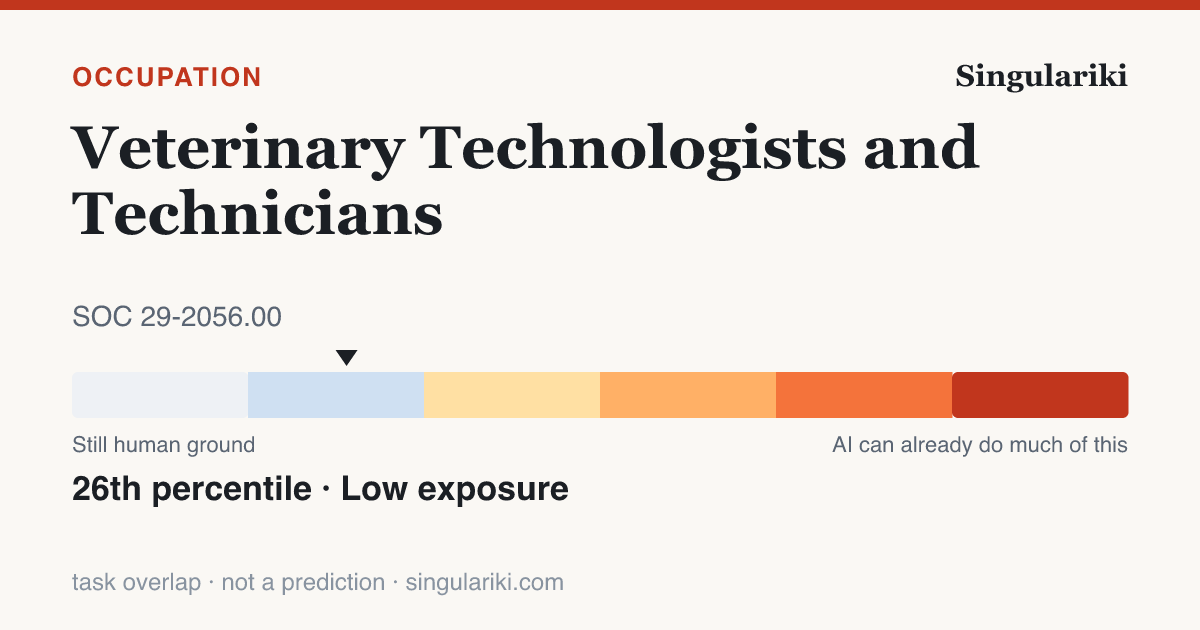
Veterinary Technologists and Technicians show 26th-percentile AI task overlap — and about 14,300 annual U.S. openings
Veterinary Technologists and Technicians rank in the 26th percentile (Low band) for AI task overlap across U.S. occupations — a measure of how much of the work today's AI can attempt, not how much is automated.Eloundou et al. (GPTs are GPTs) + Felten AIOE
The occupation is projected to see about 14,300 U.S. job openings per year (2024–34), counting growth and replacement — a labor-demand projection made independently of AI.BLS Employment Projections 2024–34
BLS projects employment to be growing fast (+9.1%) from 2024 to 2034.BLS Employment Projections 2024–34
Median annual pay is $45,980, across about 131,320 U.S. workers.BLS OEWS (May 2024)
Of the AI use actually observed for this work, 50% looks like augmentation (drafting, iterating, checking) rather than hands-off automation — from a Claude.ai usage sample, not a census.2026-01-15-v4-plus-2025-03-27-v2
Copy the whole kit
Veterinary Technologists and Technicians show 26th-percentile AI task overlap — and about 14,300 annual U.S. openings

• Veterinary Technologists and Technicians rank in the 26th percentile (Low band) for AI task overlap across U.S. occupations — a measure of how much of the work today's AI can attempt, not how much is automated. (Eloundou et al. (GPTs are GPTs) + Felten AIOE)
• The occupation is projected to see about 14,300 U.S. job openings per year (2024–34), counting growth and replacement — a labor-demand projection made independently of AI. (BLS Employment Projections 2024–34)
• BLS projects employment to be growing fast (+9.1%) from 2024 to 2034. (BLS Employment Projections 2024–34)
• Median annual pay is $45,980, across about 131,320 U.S. workers. (BLS OEWS (May 2024))
• Of the AI use actually observed for this work, 50% looks like augmentation (drafting, iterating, checking) rather than hands-off automation — from a Claude.ai usage sample, not a census. (2026-01-15-v4-plus-2025-03-27-v2)

Source: Singulariki — "Veterinary Technologists and Technicians". https://singulariki.com/roles/role-29-2056-00
Note: AI task overlap measures what today's AI can attempt, not automation, job loss, or a forecast.
Every line is built only from figures this page already shows and cites. AI task overlap means
what today's AI can attempt — not automation, job loss, or a forecast.
Sources for this page
Every figure above traces to a named public dataset and the exact release below — not
hand-written opinion. See the full methodology for what each
measure does and does not mean.
O*NET 30.3U.S. Department of Labor / National Center for O*NET Development
Data compiled June 2, 2026. Figures are estimates, not advice.
Cite this page
Plain
Singulariki. "Veterinary Technologists and Technicians." Singulariki: a source-backed encyclopedia of work. Built from O*NET 30.3; BLS Occupational Employment and Wage Statistics (OEWS) May 2024; BLS Employment Projections 2024–2034; Anthropic Economic Index v4 (2026-01-15) + v2 (2025-03-27); Microsoft “Working with AI” working-with-ai; “GPTs are GPTs” (Eloundou et al.) arXiv 2303.10130; AI Occupational Exposure (AIOE) Felten, Raj & Seamans; ILO / Gmyrek et al. GenAI exposure gradient 2025; IBS O*NET-SOC ↔ ISCO-08 occupation crosswalk 2022; Frey & Osborne (2013) frey-osborne-automation; Dingel & Neiman (2020) dingel-neiman-workathome. Accessed June 7, 2026. https://singulariki.com/roles/role-29-2056-00
APA
Singulariki. (2026). Veterinary Technologists and Technicians. Singulariki: a source-backed encyclopedia of work. Retrieved June 7, 2026, from https://singulariki.com/roles/role-29-2056-00
BibTeX
@misc{singulariki-role-29-2056-00,
  title  = {Veterinary Technologists and Technicians},
  author = {{Singulariki}},
  year   = {2026},
  note   = {O*NET 30.3; BLS Occupational Employment and Wage Statistics (OEWS) May 2024; BLS Employment Projections 2024–2034; Anthropic Economic Index v4 (2026-01-15) + v2 (2025-03-27); Microsoft “Working with AI” working-with-ai; “GPTs are GPTs” (Eloundou et al.) arXiv 2303.10130; AI Occupational Exposure (AIOE) Felten, Raj & Seamans; ILO / Gmyrek et al. GenAI exposure gradient 2025; IBS O*NET-SOC ↔ ISCO-08 occupation crosswalk 2022; Frey & Osborne (2013) frey-osborne-automation; Dingel & Neiman (2020) dingel-neiman-workathome. Accessed June 7, 2026},
  url    = {https://singulariki.com/roles/role-29-2056-00}
}
Citations name the underlying public dataset releases — they reflect what this page is built from, not just the URL.
Embed this chart
Paste this into any page. It links back here for attribution.