Skills it runs on
The capabilities O*NET rates most important for this occupation — the human ground the work is built on.
See all skills →Occupation · SOC 43-9041.00
Process new insurance policies, modifications to existing policies, and claims forms. Obtain information from policyholders to verify the accuracy and completeness of information on claims forms, applications and related documents, and company records. Update existing policies and company records to reflect changes requested by policyholders and insurance company representatives.
Also called: Claims Processor · Claims Representative (Claims Rep) · Claims Technician (Claims Tech) · Underwriting Assistant · Claims Adjudicator · Claims Analyst · Claims Clerk · Claims Customer Service Representative (Claims CSR) · Insurance Analyst · Policy Analyst · Agency Service Representative (Agency Service Rep) · Auto Claims Rep (Automotive Claims Representative)
Job family: Office and Administrative Support Occupations
A source-stamped Markdown brief of this occupation — paste it into an agent, or fetch
/roles/role-43-9041-00/context.md directly.
A fast read on where AI already shows up in this occupation, where it stays a copilot, where humans remain in the loop, and what the labor market is doing. Built from observed Claude.ai conversations mapped to O*NET tasks and from published research — measures of usage and exposure, not advice or predictions that the job is going away.
The capabilities O*NET rates most important for this occupation — the human ground the work is built on.
See all skills →Independent published positions, read together — not a forecast.
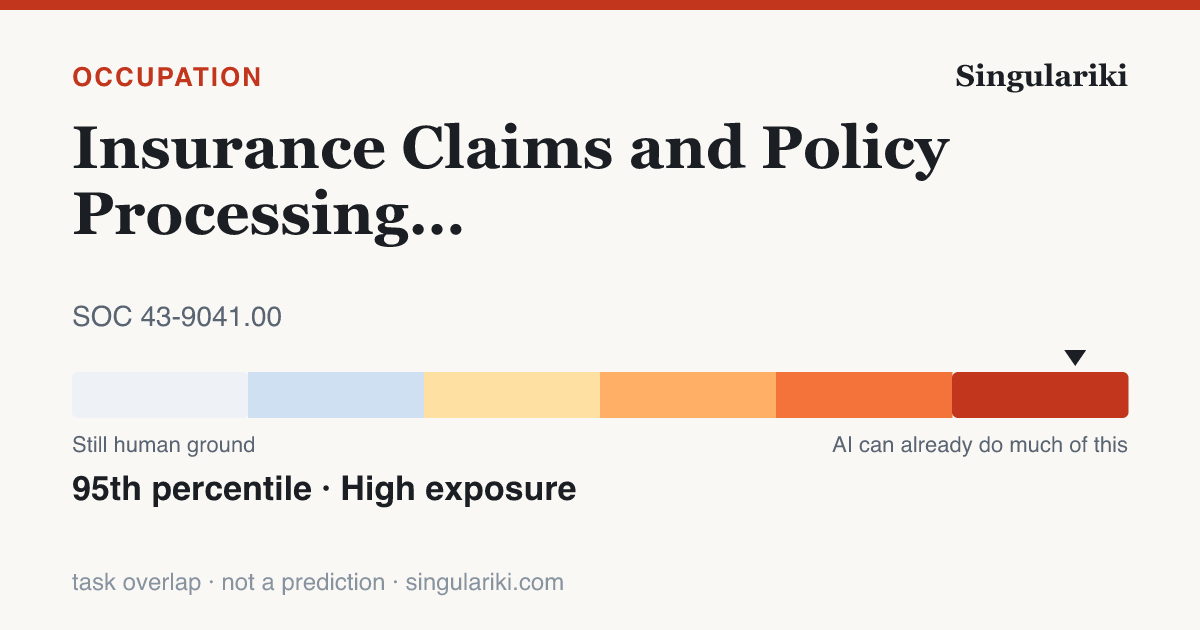
95th-percentile task overlap — yet about 20,300 openings a year (-3.7% projected, BLS) . What exposure means →
What today's research says about this occupation's exposure to AI, how AI is actually being used in it, and where employment is headed. These are positions within published studies — measures of exposure and usage, not predictions that this job will disappear.
Each study uses its own scale, so the raw scores are not comparable across rows — the percentile (this job's rank among all U.S. occupations with data) is the comparable figure, and sizes the bars.
| Measure | Rank vs all occupations | Percentile | Score |
|---|---|---|---|
| Overall AI exposure (Felten et al.) High | 84th | 1.2 | |
| LLM task exposure, γ (OpenAI / Eloundou) High | 95th | 1.0 | |
| AI assistant applicability (Microsoft) High | 90th | 0.3 |
OpenAI's exposure study scores tasks three ways: with a language model alone (α 0.7), with simple added tooling (β 0.8), and including AI-powered software (γ 1.0). Higher means more of the job's tasks could be done at least twice as fast — not that they will be automated away.
Most of this job's tasks can be done remotely (Dingel–Neiman), which tends to track with higher digital and AI exposure.
A pre-LLM (2013) estimate of how automatable this job is by computerization and robotics. Shown for historical context only — it is not part of any current AI ranking.
Frey–Osborne probability 1.0 · 97th percentile among occupations · High
Among measured AI assistant conversations mapped to this occupation (Anthropic Economic Index, 2026-01-15), these task types came up most. These are shares of observed AI conversations — not shares of the job, of worker time, or of what could be automated.
| Compose business correspondence for supervisors, managers, and professionals. | 3.0% | |
| Process, prepare, and submit business or government forms, such as submitting applications for coverage to insurance carriers. | 1.1% | |
| Process and record new insurance policies and claims. | 0.7% | |
| Review insurance policy to determine coverage. | 0.5% | |
| Organize or work with detailed office or warehouse records, using computers to enter, access, search or retrieve data. | 0.4% | |
| Examine letters from policyholders or agents, original insurance applications, and other company documents to determine if changes are needed and effects of changes. | 0.4% |
Independent U.S. Bureau of Labor Statistics employment projection for 2024–2034 — a labor-market forecast, not an AI-impact forecast.
| Outlook | Declining · -3.7% by 2034 |
| Projected annual openings | 20,300 |
| Employment 2024 → 2034 | 256,700 → 247,200 |
“Annual openings” counts new jobs plus replacements for workers who leave the occupation, so it can be large even when growth is modest.
The ILO's 2025 global study scores generative-AI exposure on the international ISCO-08 occupation system, not US SOC. Bridged through the published (and approximate, many-to-many) IBS O*NET-SOC ↔ ISCO-08 crosswalk, this US occupation corresponds to the international occupation below. Exposure here means how much of the work's tasks today's AI can attempt — task overlap, not automation, adoption, or jobs lost.
| International occupation (ISCO-08) | Task exposure (2025) | Most tasks fall in |
|---|---|---|
| Statistical, Finance and Insurance Clerks · 4312 | 64% | Gradient 4 |
Read the whole six-band gradient on the GenAI exposure gradient page. The crosswalk is approximate: a US occupation can map to several international ones, and the ILO scores describe the international occupation, not this exact US role.
All 27 tasks O*NET lists for this occupation, ordered by importance. Each links to its own page with AI-exposure and observed-use detail.
O*NET importance rating, from 1 (not important) to 5 (extremely important).
| Customer and Personal Service | 4.2 | |
| Administrative | 3.9 | |
| English Language | 3.6 | |
| Computers and Electronics | 3.0 | |
| Mathematics | 2.9 |
| Oral Comprehension | 3.6 | |
| Written Comprehension | 3.6 | |
| Oral Expression | 3.5 | |
| Near Vision | 3.5 | |
| Speech Recognition | 3.5 | |
| Speech Clarity | 3.5 | |
| Written Expression | 3.4 | |
| Deductive Reasoning | 3.4 | |
| Information Ordering | 3.4 | |
| Problem Sensitivity | 3.3 | |
| Inductive Reasoning | 3.1 | |
| Category Flexibility | 3.1 | |
| Selective Attention | 2.9 | |
| Perceptual Speed | 2.8 | |
| Mathematical Reasoning | 2.6 | |
| Number Facility | 2.6 | |
| Flexibility of Closure | 2.6 |
| Reading Comprehension | 3.5 | |
| Speaking | 3.4 | |
| Active Listening | 3.3 | |
| Critical Thinking | 3.3 | |
| Writing | 3.1 | |
| Monitoring | 3.0 | |
| Active Learning | 2.6 | |
| Learning Strategies | 2.6 |
| Time Management | 3.5 | |
| Social Perceptiveness | 3.1 | |
| Coordination | 3.1 | |
| Service Orientation | 3.1 | |
| Complex Problem Solving | 3.0 | |
| Judgment and Decision Making | 3.0 | |
| Negotiation | 2.9 | |
| Persuasion | 2.8 | |
| Systems Analysis | 2.6 | |
| Systems Evaluation | 2.6 |
Skills employers ask for in job postings for this occupation (Lightcast), with whether each is a common or specialized skill.
Showing the top 40 of 43.
How characteristic each condition is of the job, on O*NET's 1–5 context scale (higher = more present in day-to-day work). Each condition links to how it varies across all occupations.
What to study: Business, Management, Marketing, and Related Support Services . Fields of study crosswalked to this occupation (NCES CIP–SOC), not a requirement.
Share of people in this occupation at each level of education.
| High School Diploma | 54.9% | |
| Associate's Degree (or other 2-year degree) | 21.1% | |
| Some College Courses | 9.3% | |
| Post-Secondary Certificate | 7.6% | |
| Bachelor's Degree | 6.6% | |
| Less than a High School Diploma | 0.5% |
The interests and personal qualities O*NET associates with people who do this work.
| Conventional | 7.0 | |
| Enterprising | 3.9 | |
| Social | 2.6 | |
| Investigative | 2.4 |
| Office Work | 6.5 | |
| Accounting | 3.7 | |
| Finance | 3.0 | |
| Management/Administration | 2.0 | |
| Personal Service | 1.8 | |
| Law | 1.8 | |
| Sales | 1.7 | |
| Information Technology | 1.7 |
| Dependability | 3.0 | |
| Attention to Detail | 2.7 | |
| Integrity | 2.1 | |
| Cautiousness | 1.9 |
U.S. · annual wages (BLS OEWS)
| 10th percentile | $36,900 |
| 25th percentile | $41,600 |
| Median (50th) | $48,450 |
| 75th percentile | $59,500 |
| 90th percentile | $73,100 |
| People employed | 229,070 |
Where these workers are employed, by number of jobs (national, BLS OEWS). Pay shown is the occupation's national median, not industry-specific.
| Industry | Workers | National median pay |
|---|---|---|
| Finance and Insurance · Sector | 179,320 | $48,980 |
| Insurance Agencies and Brokerages · National industry | 66,730 | $48,950 |
| Direct Health and Medical Insurance Carriers · National industry | 24,150 | $48,280 |
| Health Care and Social Assistance · Sector | 13,520 | $44,840 |
| Management of Companies and Enterprises · Sector | 9,390 | $47,790 |
| Professional, Scientific, and Technical Services · Sector | 7,260 | $46,960 |
| Retail Trade · Sector | 1,910 | $46,090 |
| Temporary Help Services · National industry | 1,580 | $43,030 |
| Pharmacies and Drug Retailers · National industry | 1,380 | $46,680 |
| Information · Sector | 820 | $35,740 |
| Offices of Optometrists · National industry | 550 | $39,040 |
| Offices of Chiropractors · National industry | 520 | $36,550 |
Industries where this occupation is far more common than in the economy as a whole. The location quotient is how many times more concentrated it is here (a value of 5 means five times its economy-wide share).
| Industry | Concentration | Workers |
|---|---|---|
| Insurance Agencies and Brokerages · National industry | 45.36× | 66,730 |
| Direct Health and Medical Insurance Carriers · National industry | 36.2× | 24,150 |
| Finance and Insurance · Sector | 19.38× | 179,320 |
| Offices of Optometrists · National industry | 2.43× | 550 |
| Offices of Chiropractors · National industry | 2.4× | 520 |
| Management of Companies and Enterprises · Sector | 2.25× | 9,390 |
| Pharmacies and Drug Retailers · National industry | 1.31× | 1,380 |
| Ambulance Services · National industry | 0.49× | 120 |
Part of the Financial Services career cluster.
Side-by-side comparisons place two occupations’ pay, preparation, skills, and AI exposure on the same page — same data, same scale, no forecast.
Options the data surfaces for Insurance Claims and Policy Processing Clerks — not advice or a forecast. Each is a real cross-link you can follow into the evidence.
Capabilities this work builds that are used across many other occupations.
Occupations O*NET rates as related — the nearby moves on the map.
How people typically prepare for this work.
On the global GenAI exposure gradient this work sits around the 99th percentile of 427 international occupations.
Insurance Claims and Policy Processing Clerks show 95th-percentile AI task overlap — and about 20,300 annual U.S. openings
Insurance Claims and Policy Processing Clerks show 95th-percentile AI task overlap — and about 20,300 annual U.S. openings

• Insurance Claims and Policy Processing Clerks rank in the 95th percentile (High band) for AI task overlap across U.S. occupations — a measure of how much of the work today's AI can attempt, not how much is automated. (Eloundou et al. (GPTs are GPTs) + Felten AIOE)
• The occupation is projected to see about 20,300 U.S. job openings per year (2024–34), counting growth and replacement — a labor-demand projection made independently of AI. (BLS Employment Projections 2024–34)
• BLS projects employment to be declining (-3.7%) from 2024 to 2034. (BLS Employment Projections 2024–34)
• Median annual pay is $48,450, across about 229,070 U.S. workers. (BLS OEWS (May 2024))

Source: Singulariki — "Insurance Claims and Policy Processing Clerks". https://singulariki.com/roles/role-43-9041-00
Note: AI task overlap measures what today's AI can attempt, not automation, job loss, or a forecast.
AssetsShare imageMethodology & sourcesPress & newsroomThe newsroom
Every line is built only from figures this page already shows and cites. AI task overlap means what today's AI can attempt — not automation, job loss, or a forecast.
Every figure above traces to a named public dataset and the exact release below — not hand-written opinion. See the full methodology for what each measure does and does not mean.
Data compiled June 2, 2026. Figures are estimates, not advice.
Singulariki. "Insurance Claims and Policy Processing Clerks." Singulariki: a source-backed encyclopedia of work. Built from O*NET 30.3; BLS Occupational Employment and Wage Statistics (OEWS) May 2024; BLS Employment Projections 2024–2034; Anthropic Economic Index v4 (2026-01-15) + v2 (2025-03-27); Microsoft “Working with AI” working-with-ai; “GPTs are GPTs” (Eloundou et al.) arXiv 2303.10130; AI Occupational Exposure (AIOE) Felten, Raj & Seamans; ILO / Gmyrek et al. GenAI exposure gradient 2025; IBS O*NET-SOC ↔ ISCO-08 occupation crosswalk 2022; Frey & Osborne (2013) frey-osborne-automation; Dingel & Neiman (2020) dingel-neiman-workathome. Accessed June 7, 2026. https://singulariki.com/roles/role-43-9041-00
Singulariki. (2026). Insurance Claims and Policy Processing Clerks. Singulariki: a source-backed encyclopedia of work. Retrieved June 7, 2026, from https://singulariki.com/roles/role-43-9041-00
@misc{singulariki-role-43-9041-00,
  title  = {Insurance Claims and Policy Processing Clerks},
  author = {{Singulariki}},
  year   = {2026},
  note   = {O*NET 30.3; BLS Occupational Employment and Wage Statistics (OEWS) May 2024; BLS Employment Projections 2024–2034; Anthropic Economic Index v4 (2026-01-15) + v2 (2025-03-27); Microsoft “Working with AI” working-with-ai; “GPTs are GPTs” (Eloundou et al.) arXiv 2303.10130; AI Occupational Exposure (AIOE) Felten, Raj & Seamans; ILO / Gmyrek et al. GenAI exposure gradient 2025; IBS O*NET-SOC ↔ ISCO-08 occupation crosswalk 2022; Frey & Osborne (2013) frey-osborne-automation; Dingel & Neiman (2020) dingel-neiman-workathome. Accessed June 7, 2026},
  url    = {https://singulariki.com/roles/role-43-9041-00}
} Citations name the underlying public dataset releases — they reflect what this page is built from, not just the URL.